Translations and Frictions: A written conversation between Kamran Behrouz, Yvonne Schmidt and Nina Mühlemann
von Nina Mühlemann, Yvonne Schmidt und Kamran Behrouz
Erschienen in: Recherchen 180: Im/Mobile Möglichkeiten – Zugänglichkeit und Verantwortung in den performativen Künsten (07/2026)
Via the following link you can watch the video.
Einfach gesagt:
Übersetzungen und Reibungen: Ein schriftliches Gespräch zwischen Kamran Behrouz, Yvonne Schmidt und Nina Mühlemann
Kamran Behrouz macht Kunst. Gemeinsam mit der Theatergruppe Criptonite hat Kamran am Stück Creature Comforts gearbeitet. Nina Mühlemann ist bei Criptonite dabei. Yvonne Schmidt war im Publikum von Creature Comforts. In diesem Beitrag unterhalten sich die drei über das Stück. Dabei gehen sie vor allem auf diese 3 Punkte ein:
1) Die Grundidee des Stückes
Jede Person im Publikum hat einen Fragebogen ausgefüllt. Danach wurde jeder Person eine Mini-Performance zugeteilt. Insgesamt gab es 3 verschiedene Mini-Performances. Paloma Ayala, V Pierzynski und Kamran Behrouz haben die Mini-Performances geleitet. Bei Paloma gab es Essen. V hat einen Zungentanz aufgeführt. Bei Kamran konnte man ein Video anschauen. Im Fragebogen ging es nicht nur um Barrierefreiheit. Es ging auch darum, worauf man gerade Lust hatte. Die 3 Mini-Aufführungen haben gleichzeitig stattgefunden. Die Hälfte des Publikums war in den Zelten. Edwin Ramirez, Alessandro Schiattarella und Nina Mühlemann haben zur selben Zeit für die andere Hälfte gespielt. Danach gab es einen Wechsel. Jede Person konnte nur 1 Mini-Performance sehen. Eine wichtige Idee des Stückes war: Es ist okay, wenn man Dinge verpasst.
2) Herausforderungen in den Proben und Aufführungen
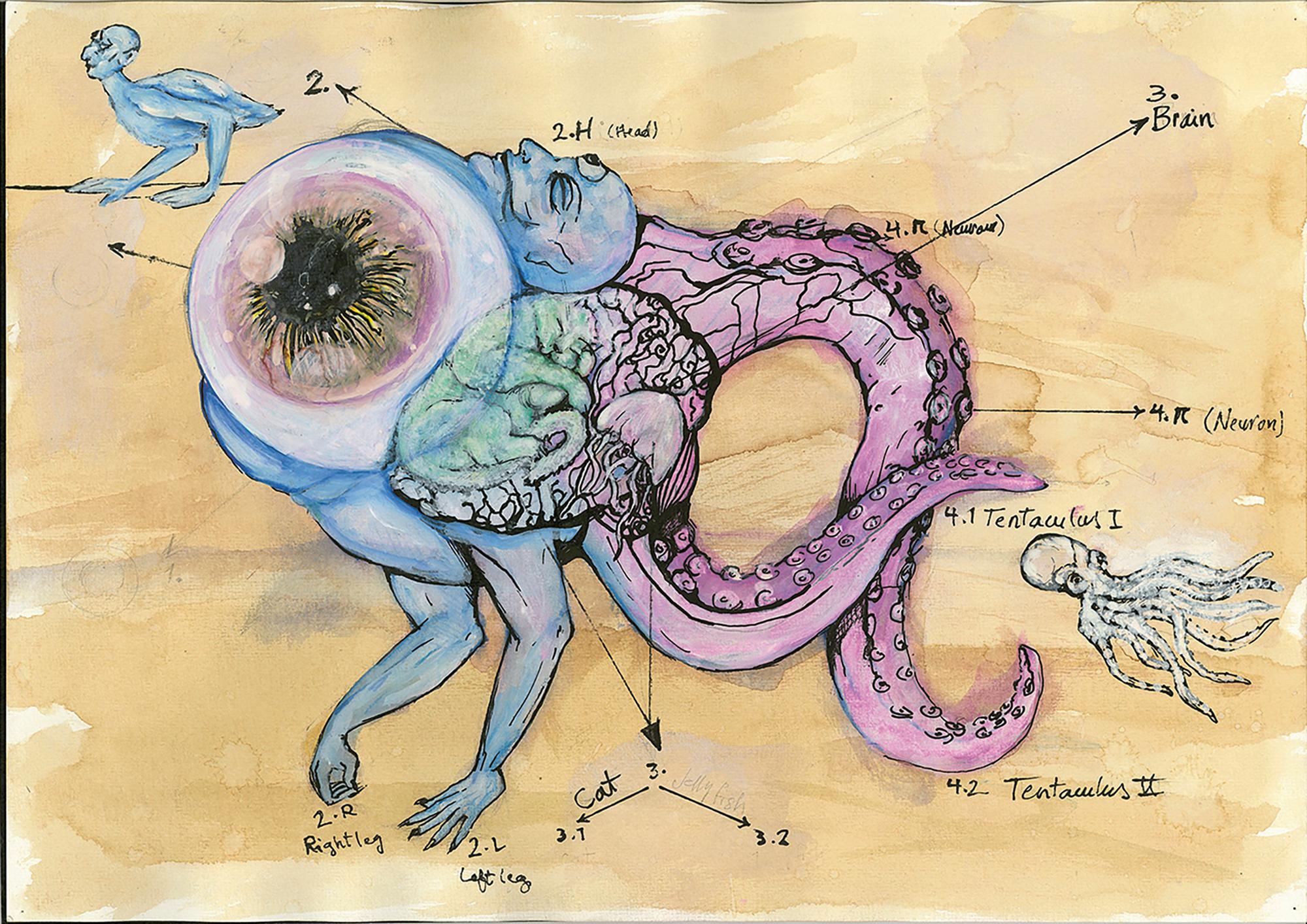
Es war schwierig, die Zeitabläufe im Stück festzulegen. Viele Dinge haben gleichzeitig stattgefunden. Deshalb haben Publikum und Spielende manchmal Kopfhörer gebraucht. Es gab auch einen Ruheort im Raum. Dort konnten sich die Spielenden und das Publikum zurückziehen. Das Stück hat in der Welt von Gullibilius gespielt. Gullibilius ist ein Fantasie-Geschöpf, das Kamran gemalt hat. Das Publikum hat sich an verschiedene Orte im Raum bewegt. Diese Orte haben Körperteile von Gullibilius dargestellt. Es gab zum Beispiel den Magen, den Mund und das Gehirn. Kamran hat Gullibilius für sich selber gemalt. Kamran wollte ausdrücken, wie sich Autismus anfühlt. Für Kamran war es schwierig, dass Gullibilius im Stück für alle wichtig war. Eine weitere Herausforderung war, dass mehrere Personen vom Team in der Probenzeit mit Covid krank waren.
3) Übersetzungen
Im Stück gab es verschiedene Übersetzungen: Kamrans Zeichnung von Gullibilius wurde in den Raum übersetzt. Inhalte für sehende Menschen wurden für blindes Publikum übersetzt: zum Beispiel Kamrans Video. Danach hat sich das Video noch einmal verändert. Die Übersetzung hat also in beide Richtungen stattgefunden. Kamran war neben dem Video und hat mit dem Publikum an einem Laptop gechattet. Für einige Inhalte des Stückes gab es eine Übersetzung in deutschschweizer Gebärdensprache.
Kamrans Video:
Kamran hat für das Stück ein Video gemacht. Ein Teil des Publikums hat sich das Video angeschaut. Im Video verschmelzen die Spielenden mit fantastischen Wesen: zum Beispiel mit Pilzen und Quallen. Die Gesichter der Spielenden sind Teil dieser fantastischen Wesen im Video.
This text is a collaboration between Yvonne Schmidt, Kamran Behrouz, and Nina Mühlemann. It is a conversation about the piece Creature Comforts by Criptonite and Symbionts, which premiered in October 2023 at Tanzhaus Zurich. Nina Mühlemann, artistic co-director of Criptonite, and Kamran Behrouz, a visual/digital artist, collaborated on the piece. Yvonne Schmidt was there as an audience member. The conversation was held via a document into which all three participants wrote their questions, answers, and thoughts simultaneously.
Nina: For me, Creature Comforts was unlike any other piece of theatre I have worked on or even seen. The base idea was to challenge the notion that an audience perceives a piece of theatre in unison as much as possible, because that is never true – if a group of people attends the same piece, all the experiences will be different. This is particularly true if we take disability into account. So I wanted to create a piece that emphasizes and heightens that idea and also expects from non-disabled audience members some of the same things that are usually only expected from disabled theatregoers – having to declare needs and preferences in advance, having the experience shaped by that advance information, and missing out on other parts of the piece.
We worked with what we called, both in the description of the piece and the piece itself, the »joy of missing out«: audience members had to fill out a test, and based on their results, they attended one of three short, small audience pieces within the piece and did not get to witness the other two.
As the piece was interested in creatures, symbiosis, and the senses, one of those short pieces was an experience with tasting food, created by artists Paloma Ayala and Jenn Unfug, one was an experience about the tongue, featuring a guided tongue exploration by artist V Pierzynski, and the third one was Kamran’s piece.
Kamran: To me personally, Creature Comforts was a practice of what I was trying to theorize but never had the access to articulate properly. A symbiotic practice of multifaceted translations that not only creates a space for disability on the stage but also simultaneously works with the flows of the space to make it accessible for the disabled audience and confront the non-disabled audience to face challenges that otherwise they never have to deal with in a usual theatre piece.
Yvonne: For me as an audience member, it was interesting that the audience members were not put into different groups according to their access needs/language skills, etc., but according to our pleasures. As Nina said, in disability performance audiences are never addressed as a collective entity, but there are different layers of the performance that happen at the same time (visual aspects, audio descriptions, sign language, etc.). Sophia Neises has written about this aspect of an aesthetics of access, that there is always something missed. And Brenda Brueggemann writes about the performance Storm Reading how the rhetoric triangle is challenged in disability performance when it becomes unclear who is speaking (Brueggemann et al.). In Creature Comforts, this notion of simultaneity was taken to the extreme.
This leads to the aspect of translation that seems to be crucial in the performance. I attended a group led by Kamran, who created a video/visual poem … @Kamran: Do you want to say more about this?
Kamran: Yes, exactly, that’s what I was trying to say about a multifaceted translational event.
Nina: Yvonne, it’s interesting you mention that it didn’t feel like people were sorted into experiences according to their needs or access needs. Because this was one of the parts in the piece where there was a friction between what we set out to do and what was realistic. Ideally, we would have had audio description in all experiences and made sign language possible in all of them. However, due to the resources and other factors, such as the layout in the small tents the performances happened in, we could only offer two experiences where each of those access measures was possible. We also knew from the get-go that one experience would involve food and licking, so it definitely wouldn’t be safe for people who are required to wear masks. It was really important to us that people get a real choice according to their wishes and pleasures, but ultimately we could only offer a choice between two out of three experiences for people who needed audio description, sign language, or masks due to the nature of these little performances inside the overall experience. We still regarded this as somewhat of a success because there was still a choice between two options.
Yvonne: Nina, yes, in my group there were some people who used sign language. There was a simultaneity of different languages in the same moment happening: typewriting, sign language, and the visual language of the video.
It’s interesting, Nina, that you are talking about frictions between access needs and the artistic concept. I’m wondering if there were more frictions during the rehearsal process?
Nina: Oh yes, absolutely. It was the piece of frictions. For us (Edwin and me, the co-artistic directors), it was such an honor to invite five other performers to work with us (Alessandro Schiattarella, V Pierzynski, Paloma Ayala, Jenn Unfug, and Kamran). However, this also meant that there were a lot of ideas of what people wanted to do, and for all of them to happen simultaneously was a big challenge. The main issue that we realized very quickly would come up was the overall noise level, so some of the performances needed to happen via headphones, and we had to figure out which ones and how to make it possible on a technical level.
Also, all the performers were very game to work with access measures, but there were different experience levels present – some of the performers did not fully realize what it would mean to work with audio description or that people might need different seating options, etc., so figuring this out for each part of the show was a lot of work and sometimes meant people could not quite do artistically what they had envisioned, they had to adapt their vision.
The most stressful moment was when we had a Covid outbreak and wave within our team, and for a moment it almost seemed like we would have to cancel the premiere. Luckily, everyone who could not be replaced was negative on that date, so we went through with the premiere, but again, this meant some drastic adaptations for all of us, because we decided that unless every one of us had tested negative for three days in a row, all performers would wear masks. V and Paloma had to do a very limited version of their performances (the tongue gym became a closed-eye meditation, and some of the food at Paloma’s station could not be served), and Alessandro and I had to sing Meat Loaf with a mask, which was quite the challenge.
Another huge friction for Edwin and me was that we spent a lot of time thinking through logistics – where people would go, how things needed to be communicated, and how people would be sorted into groups. Our amazing dramaturg Nele Solf (who luckily also has some coding skills!) spent many days developing the test and the sorting system. All of this meant that Edwin and I had very little time to develop what we would do performance-wise, because as artistic directors there were so many other things we needed to take care of.
Kamran, can you think of other frictions?
Kamran: From the beginning, the main friction for me was dealing with the concern that I am not imposing my idea of »Gullibilius«. To find ways to observe how performers adapt in the room and in relation to it was sometimes very difficult. I was not used to collaborating on such an intimate subject with a collective. But the core point of a symbiotic practice is the matter of care. I might use the word micropolitics of care way too much, but I guess that is exactly what made the frictions not only productive (in terms of access and storytelling) but also create a performative temporal experience that is perhaps even impossible to re-create.
Yvonne: Another interesting frictional aspect in Kamran’s performance is the interaction between the avatar in the video and the physical presence of Kamran at the same time. Kamran communicated with the audience by writing on their laptop and did not use spoken language at all.
Kamran: Shortly after receiving my autism diagnosis, I painted Gullibilius as a map to communicate my sensory issues with my therapist. Since I am more of a visual communicator, it was easier to draw it rather than talk about it. One of the major aspects of this work for me was the way my inner world (map) was embraced by Criptonite and the collective and translated into a space. The significance of this was related to the map being about autism. (Autos) or the self as a core point of the so-called »autism deficit« turned inside out and brought into the public. So again, it allowed me to not only continue my avatar translations but also use different communication strategies (e.g., typing influenced by Tito3). This allowed me to embrace my autism for the very first time on the stage. And yes, indeed it was a piece of friction, as I had never been so vulnerable and intertwined with a piece.
Nina: A few weeks before rehearsals started, Kamran showed me this creature they had drawn, Gullibilius. At this point, even though we knew it would be an installative piece about the senses, we had not figured out in what »world« the piece would take place. Kamran had mapped different parts of Gullibilius, such as the brain, the tentacles, etc., and the way Kamran talked about Gullibilius being a creature but also a map gave birth to the idea that Gullibilius could be the world of this piece, that the different stations represented different parts of Gullibilius, such as the stomach, the eye, the head, and the brain. The characters would not only live in symbiosis with each other but also with Gullibilius. I feel so honored that Kamran allowed us to make Gullibilius part – one of the main parts! – of this piece.
Yvonne: Indeed, the stage setting reminded me of a map with different spots, some of which were visible. Other parts happened in a kind of tent that you could not see if you weren’t in the designated group. This roused my curiosity as to what goes on behind the scenes here. It was a provocation that you could not take a look into the (other) tents/behind the curtains. Was this intentional? Or was it also for accessibility (as the tents also protect)?
Nina: Very early in the development of the piece, it became clear that Paloma and Jenn could not cook for 30 people each night, or whatever we thought at that point the capacity would be (in the end it was 32). They felt ten to twelve would be manageable. So there was a practical need that only some people would have that experience. When Edwin, our dramaturg Nele and I talked about it, we realized that we were quite fond of the idea that not everyone gets to do everything – as disabled people, we are constantly told that some experiences or spaces are not open to us, and it is something we have to expect. It is also part of life, but disabled people are more and earlier aware of it. So we tried to heighten this aspect and really play with »the joy of missing out.« However, performers also got some agency over how they wanted to put this into practice: for Kamran’s space, Kamran decided together with our set designer that the space should not be fully curtained off, that people who were not assigned to this performance could peek, but that the headphones and seating spaces were reserved for those who were assigned this performance. Paloma and V wanted mostly closed spaces, with the occasional moments where people are allowed to peek inside, because they felt licking or doing tongue exercises were very personal experiences that should be reserved for the small groups without being watched. A final concern was also that if audience members had been able to watch the other experiences, it again would have privileged the sighted people, which we were very clear about – we wanted to avoid that as much as we could.
Yvonne: I am interested in typewriting as a performance itself. In disability performance, technical devices that are used as support structures shape the aesthetics of the performance. For example, the disabled artist Larry Eigner used his typewriter in a certain way because of his disability, which created a special approach to poetry related to Tobin Siebers’ notion of »disability aesthetics« (Davidson 27). @Kamran: Can you say more about your use of typewriting and Tito?
Kamran: Autism literature is a part of my references in my PhD. When I encountered Tito, who wrote the book Plankton Dreams, I felt I opened a door that was locked until then. Tito is a nonverbal autistic author who wrote about his inner world (autos) in special education school and applied the idea of analyzing, or rather experimenting with neurotypicals to study them (as an autistic person). The book is a testimony of what autism is and how much the lack of access to the inner world of the autistic children (translation) led to the horrible history of the word »autism«. So when I saw Tito’s talk for the first time, he was sitting next to his mom in front of a computer, which was projected onto a wall for the audience, and he answered their questions in exactly the same way as we are writing now. I found it not only liberating but also mind-blowing :)) so when I suggested this and it was embraced by the collective, it added a corporeal experience for me to the stage, which is better expressed as »unmasking«.
Yvonne: Kamran, thank you for sharing. What do you mean by »unmasking«? I also found it interesting that you decided to wear a costume on stage, which is a kind of a »mask«. Can you say more about this?
Kamran: The term »unmasking« regarding autism is often understood as not hiding autism traits, but it also means to me to »not pretend« normalcy (hegemony). Yes, you are right that the costumes might be perceived as a »mask(cover)«, however, most of the costumes and props are rather ways to break through the mask of normalcy (or rather constructed reality). Just like with drag queens, sometimes unmasking and being absolutely honest needs layers to construct a different reality, where one can be themselves. Gullibilius in fact works the same for me. Only through such a fictional character could I embrace my reality of autism and perform it in symbiotic association with Nina, Edwin, Paloma, V, Ale and Jenn, and Nele.
Nina: In terms of »unmasking«, we tried to have several things in place, both for audiences and performers. One aspect was that there was pre-show access, which allowed audiences to get acquainted with the space, sound, and lights before the show. Another measure was that within the performance space, there was a small curtained-off space with stim toys, noise-cancelling headphones, a weighted blanket, and pillows. The idea was that both performers and audiences could go there for a break, and both performers and audiences used it – of course performers had to pick moments where they did not have specific things to perform or prepare, but some of us used it. For audiences it was useful, because when you leave the performance space at Tanzhaus, you immediately enter a noisy, trendy bar. So, this was an alternative way to take a break. And of course, you could also choose to be there and still hear a little bit of the piece, it created sort of a space in between the performance and the outside world …
Yvonne: Performance also goes beyond the idea of performance as an (ephemeral) work of art with a beginning and an end or as a linear process. Creature Comforts in contrast, is more a non-linear series of different micro-performances that contain different layers within themselves. Some of the actions are staged, but a lot of it happens in the little moments of interaction between spectators and performers. Whereby the spectators themselves become performers. This can also be found in many telematic performances, where exactly the same questions are asked about the artwork/performance concept. It’s a kind of environmental performance, but disability adds another level to the experience.
I can imagine that every show was quite different depending on impro and audience. Any thoughts on this?
Nina: We were really interested in how audiences shape the piece. It was a huge learning process to figure out that the comfort to interact varies greatly for people, even if you provide a lot of accessibility, and it is something we could only work on properly once we had test audiences. For the test audiences, we specifically made sure that there were disabled, neurodivergent, and chronically ill people present so that we could figure out accessibility as it unfolds (Price 159). Sadly, due to the Covid outbreak, we had to cancel some of them. In the piece, Edwin, Alessandro, and I play otter, sea slug, and jellyfish-like creatures that chat and dance with audiences but also guide them through the piece. So, the energy and joy some audience members had really affected our ability to do that, and it became quite challenging when, for example, someone was not happy with the performance pathway they were assigned to. Personally, there were some beautiful moments for me, like dancing with an audience member in her 70s or having very intimate storytelling experiences with one or two people.
During some of the shows, the audiences were more reserved, and towards the end of the performances, Alessandro, Edwin, and I learned that then we would have to interact more between ourselves, dance with each other, and tell each other stories, but it was a learning process to get there.
Yvonne: Yes, I very much liked the little »in-between-performances«, where the audience could interact directly with the performers. This was quite intimate and at the same time not intimidating, as there was no pressure to get involved as an audience member. There were a lot of different »objects« in the space where you could sit or lie down. You could choose your own position in the room as an audience member and your level of involvement (physically but also mentally). At some points it was quite an immersive experience, but then I could also just lay down and look at the ceiling. So, there was also the pleasure of missing out during the interim performances.
Kamran: What was beyond friction and rather a new proposition for me was the new layers of translations that were activated by Criptonite’s practice of creating access. Access not as an afterthought but rather building and thinking with the notion of accessibility from the first step. For instance, regarding the audio description of the video that I made for my station, it was not only a translation of images into words to make it accessible for blind and visually impaired audiences, but it was also a way to translate the visually impaired perspective into the narrative for the animation and adapt with it and learn more about what needs to be translated, which in fact influenced the narration of the video and emerged as the main narrative of the piece.
Yvonne: The relationship between video/visual and text/creation could also be called »symbiotic« – a word that you are using a lot. I’m wondering how the symbiosis is related also to accessibility and disability, since it’s also related to interdependency, a term that disability scholar Petra Kuppers calls a core value of disability culture (Kuppers 118). Any thoughts on this? Or maybe explain how you are using the term symbiotic?
Nina: For me it was a really symbiotic experience. We worked with Noah Mundinger for the piece, an audio description expert. We invited them as a dramaturg for blind audiences, so we also discussed pathways with them, set design, and ways blind audiences could move through the space. One great idea they had was to create a small 3D model of the whole set, which assisted with tactile orientation.
When it came to Kamran’s video, we first tried to create an audio description draft with very little input from Kamran. What then happened was that from there, we adapted parts of the audio description with Kamran’s input, but Kamran also adapted parts of the video to fit the audio description, both in terms of length (in certain sequences we needed more time to describe) and in terms of content. I found the practice to alter part of the piece to accommodate the audio description really interesting as a method.
Kamran: You know, I was finalizing my chapter about avatars, and of course it brought me back to »prosopagnosia« … it made me think about invisible disabilities again. I am dealing with a lot of internalized shame to talk about this subject and how much it affects my life (as a core of my anxiety). I would like to talk about this with you in relation to Creature Comforts.
Yvonne: Thank you for sharing this. I would like to read your dissertation sometime when it feels appropriate for you. I think invisible disability on stage is a very political thing, and also using avatars or other objects. It makes me think of the performer Hendrik Quast’s 2022 piece Spill your Guts, where he created a puppet to talk about his invisible disability caused by his autoimmune disease. He learned ventriloquism for this piece. The question of who is speaking – the puppet/avatar or the performer – and is a way to make something appear that is invisible are very prevalent in his work.
Kamran: Yes! The Puppets of Hendrik function exactly the same way as avatars, but for a very long time I hid, or rather unconsciously concealed, my shame with theories about virtual reality and performance. I just realized talking about shame is the most political part of this attempt. Something that for way too long I did not know how to articulate.
To link it to what Yvonne asked about symbiotics, I would like to say that what I am trying to reflect on is about collective networks of translations. If we consider disability (and neurodivergence) as a core of human diversity, then multi-layers of translations can become a form of access embedded in space. I think what I understand as symbiotic practice is rooted in what I am trying to theorize as »cosmopolitics« in my PhD. Also, as Nina said, the whole process of »thinking-together« and thinking with the issues (e.g., inaccessibility) was a symbiotic practice for me too.
Nina: It is really interesting, Kamran, what you say about hiding or concealing through practices or theory – would you call this a form of masking?
Kamran: Yes, exactly. I contextualized this shame in my research and the theoretical part as a form of masking. And to unmask is to talk about shame. The final segment of my research is related to Creature Comforts to reflect on »healing through collective shame«.
I also believe the other end of shame needs more nuanced terms than shamelessness. I think the problem with shame and disability is the way it becomes part of the natural flow of life, because it is a long and slow form of violence. The problem with the internalization of shame is really evident, at least in my own subconscious, whenever I accidentally find an ugly piece of internalized ableism.
One of the things that I am analyzing in my work is the word »shame« itself. As if everyone is on board with it. »Scham« in German, »shame« in English, »Sharm« in Farsi, Urdu and … funnily, in all these languages, shame is also associated with sex/genitals; »Sharmgah« in Farsi (refers to genitals) or the term »weibliche Scham« in old medical handbooks.
Yvonne: Yes, in German, »Schamhaare« is pubic hair. It has to do with physical hostility (»Körperfeindlichkeit«), which also goes hand in hand with ableism. I just found a paper on Plato and contemporary politics of shame, saying that most contemporary theories on the politics of shame that consider shame a pernicious emotion that we need to avoid are built on an oversimplistic dualism of shame and shamelessness. Shame is labeled as something bad – but maybe it could be something that we can embrace as well – sorry, I forgot what I wanted to say … Shame is always connected with norms and what kind of performance is desired in a particular context. Relaxed performances as a form of disability performance shift these norms, in which, for example, audience behavior for which one would be ashamed in the theatre as a specific space (noises, falling asleep, etc.) is welcome and not shameful.
Nina: In my thesis I wrote about pride and shame, and Eliza Chandler, a disability scholar, argues that shame cannot simply be abandoned for pride, but that shame is a part of the disability experience we need to connect to, and shame and pride cannot exist without the other (Chandler 85). So, this is very much in line with what both of you are writing.
I think when it comes to audiences, immersive or interactive performances in particular are spaces that can create a lot of shame – am I interacting and engaging »correctly«?. But not just for disabled audiences, for everyone, and you can level this a bit by giving options and by being explicit about what is allowed and not allowed, which are also techniques used in Relaxed performances.
Kamran: I don’t know how to put it, but what Criptonite as a collective did for me personally as an audience member (before Creature Comforts) was tightly linked to a radical dismantling of shame in a space where I did not feel at home (which, as Nina mentioned, is part of a performance dynamic sometimes). Yes, I am simultaneously reading Nina’s and Yvonne’s points about Relaxed performance, and it is very interesting and makes me think again how much getting away with the discomfort of performance was related to the way I morphed into avatars and virtual reality.
Nina: Thank you, Kamran, that’s lovely to hear. I think it relates to methods of Relaxed performance, which we used before – such as that you don’t have to sit through the whole piece, you can go in and out, and the pieces are constructed in sequences rather than one gigantic narrative. And also to give explicit permission to move, to make noise, and to stim. But I also think it’s crucial to work with the disability community. Only if disabled audiences show up will a relaxed atmosphere truly happen – I would actually argue that in order for a Relaxed performance to be truly that, you need an audience that is relaxed, otherwise the pressure to conform might still be there, regardless of what the performers do.
Kamran: I do agree that the audience is the key to a Relaxed performance. But to truly make it relaxing, performance needs core care and multilayered translations to accommodate the audience, and that is what Creature Comforts is about. But of course, to draw a parallel, most of these works are done by disabled people who are doing the translational work. This can be exhausting over time, as we really need structural and institutional assistance to change this dynamic. I do not know, I just felt I needed to say it here. Because sometimes it hurts me to see the amount of work and stress you (Nina) and Edwin have to do just to make the space more bearable. This should become part of the institutional assistance.
Yvonne: Yes, and also disabled performers who play with »disability humor« engage with this. I’m thinking of Touretteshero or the Chicago-based performer Tekki Lomnicki who deals with disability humor in everyday life. But back to Creature Comforts: I think it’s interesting what you, @Nina, are saying about the way disability creates a different kind of storytelling (not one linear narrative, etc.). I wrote a piece on disability and postdramatic theatre a while ago, as I think there are so many connecting points, in particular in terms of dramaturgy and storytelling (Schmidt 155). This also goes back to what has been said about translation in terms of access and the multilayered-ness of the performance – that there is not one dominant understanding or narrative, but more a simultaneity of different actions on stage.
Nina: I think different perceptions, different minds and bodies in the audience create different experiences anyway. And then, of course, this is ten times truer when some minds are tuned into sign language, some into haptic and auditory ways of perceiving, and some people drop more in and out of the performance than others (although everyone’s mind wanders and drops in and out, it’s such a myth that humans can stay fully focused for a 90-minute piece). And then with Creature Comforts, we took these ideas to some kind of extreme, asking audiences to truly create their own piece, in a way. And what we gave them were just offerings they could choose or not.
Yvonne: I am curious if there were any unexpected reactions from the audience members? As an audience member, I had a lot of freedom, but it was also helpful to have some guidance. So, I am wondering how you balance access and individual audience experiences and the necessity to give some supporting structures.
Nina: There were definitely unexpected reactions – although in part we also really did not know what to expect at all, so most reactions were unexpected in that way. The questionnaire people had to do in order to decide which performance they were assigned to definitely threw a lot of people off, some hated having to do it, and some loved it. What was interesting about that aspect was that it mimicked the labor disabled people have to do when they go to the theatre (or even just leave the house): making sure that there is access, trying to anticipate what they might need, and expressing this to strangers. It can be vulnerable and uncomfortable. So it was definitely interesting to put non-disabled people into that position.
And another interesting thing was that we explained the »joy of missing out aspect« of the piece a lot – in the piece description, as people entered, and also after the break. That audiences will only get to attend one of the smaller spaces. And still there were quite a few people who were confused and asked when they would get to see the other spaces, and some were quite annoyed that they would not get to. And again, it is interesting to me because it mimics disabled reality: As disabled people, we are so used to the fact that there are whole experiences that are »not for us« because they are not accessible. Or that there are aspects we will miss out on. So, this idea that someone has a right to experience absolutely everything and gets mad when things are not designed that way is quite funny to me because that is non-disabled privilege in a nutshell. But what we tried to be really careful about was, that for non-disabled people, this was not put on top of the usual restrictions we already experience due to a lack of access.
References
Eliza Chandler: »Interactions of Disability Pride and Shame«, in: Erica L. Johnson and Patricia Moran (Eds.): The Female Face of Shame, Bloomington 2013, pp. 74–87.
Michael Davidson: »Missing Larry: The Poetics of Disability in Larry Eigner«, in Jennifer Bartlett, Sheila Black, and Michael Northen (Eds.): Beauty Is a Verb: The New Poetry of Disability, El Paso 2011, pp. 27–33.
Petra Kuppers: »ADAPT in Space! Science Fiction and Disability: Storying Interdependence«, in: Bree Hadley and Donna McDonald (Eds.): The Routledge Handbook of Disability Arts, Culture, and Media, Milton Park 2018, pp. 118–131.
Mukhopadhyay, Tito Rajarshi: Plankton Dreams: What I Learned in Special-Ed, London 2015.
Margaret Price: »Un/Shared Spaces«, in: Jos Boys (Ed.): Disability, Space, Architecture: A Reader, Milton Park 2016, pp. 155–172.
Schmidt, Yvonne. »Disability and Postdramatic Theater: Return of Storytelling«, in: Journal of Literary and Cultural Disability Studies, vol. 12.2 (2018), pp. 155–172.
Notes
1 Vgl. Sins Invalid Blog. (2011). Have you found a date for the Sins Invalid webstreaming yet? https://www.sinsinvalid.org/blog/have-you-found-a-date-for-the-sins-invalid-webstreaming-yet?rq=online [letzter Aufruf am 10.05.2022].
2 Siehe https://2022-23.implantieren-festival.de/de/blog/come-as-you-are-1/ [letzter Aufruf am 22.01.2025].
3 Tito Rajarshi Mukhopadhyay, an autistic writer who used communication assistance, see references.