Care, Community and Contingencies: Artistic Practices Rooted in Access
von Nina Mühlemann
Erschienen in: Recherchen 180: Im/Mobile Möglichkeiten – Zugänglichkeit und Verantwortung in den performativen Künsten (07/2026)
Assoziationen: Schweiz Dossier: Inklusion Alexandrina Hemsley
Einfach gesagt:
Fürsorge, Gemeinschaft und flexible Pläne: Künstlerische Praktiken, die auf Zugang basieren
Der Text untersucht: Wie machen behinderte und chronisch kranke Künstler*innen Kunst, wenn sie mit ihrem Körper nicht im Raum sein können? Wir meinen oft, dass Künstler*innen immer reisen und live auftreten. Aber viele behinderte Künstler*innen arbeiten schon lange anders: digital, langsam oder so, dass sie kurzfristig den Plan ändern können.
In der Pandemie durften wir manchmal gar nicht reisen. Oder weniger. Live-Veranstaltungen sind ausgefallen. Wir mussten deshalb alle anders arbeiten. Darum wurden die Arbeitsweisen von behinderten Künstler*innen sichtbar. Und das war wichtig.
Im Text geht es um 2 Künstler*innen:
Alexandrina Hemsley (UK): Die Arbeit von Alexandrina besteht aus Tanz, Film, Veröffentlichungen und Vorträgen. Alexandrina arbeitet immer anders – je nachdem, wie es ihrem Körper gerade geht und was sie braucht. Die Arbeit von Alexandrina zeigt: Gemeinschaft gibt es auch ohne Live-Vorstellungen. Auch Filme und andere Dinge machen Gemeinschaft und Kunst möglich.
Angela Alves (Deutschland): Wenn Angela Kunst macht, gibt es viele Momente mit Ruhe und Barrierefreiheit. Menschen liegen zum Beispiel. Angela stellt ihr Bett aus, und das Publikum liegt darin und hört sich Geschichten an. Manchmal übernimmt das Publikum auch Aufgaben, die Angela nicht machen kann. Angelas Arbeiten sind auch für gehörlose, blinde und neurodivergente Menschen. Neurodivergente Menschen nehmen die Welt anders wahr. Sie hören zum Beispiel mehr Geräusche. Oder neurodivergente Menschen brauchen mehr Ruhe.
Manchmal sind bestimmte Dinge nicht möglich. Alexandrina und Angela planen für diesen Fall andere Möglichkeiten, ihre Kunst zu zeigen. Alexandrina und Angela sprechen darum auch über Crip Time. Crip Time beschreibt, wie behinderte und chronisch kranke Menschen Zeit erleben und mit Zeit umgehen. Zum Beispiel, wenn sie oft Pausen brauchen. Beide nennen auch die Bedeutung von Fürsorge und Barrierefreiheit. Sie zeigen: Behinderung bringt neue Wege, Kunst zu machen.
Der Text sagt: Kunst muss sich anpassen. Kunst muss für alle da sein. Kunst muss darauf achten, was Menschen brauchen. Dann können auch behinderte Künstler*innen arbeiten. Und behinderte Menschen können auch im Publikum dabei sein.
Bern Academy of the Arts (HKB/BFH)
The Disability community is magical but elusive: rarely is it as straightforward as marching with other self-identified crips through a city, sequined outfits glistening in the sunshine, disability pride slogans taped onto mobility aids. Sometimes it is lying on a sofa in Zurich, Switzerland, chatting on Zoom to a fellow disabled artist in London, who is lying on their sofa, snacking on Nori chips. Sometimes it is lying on a bed together in an exhibition space with two fellow disabled artists, nestling our heads into the mattress, listening to stories about rest while we are watched by mostly nondisabled people.
Those two examples come directly out of my research as a postdoc for the SNF-funded research project Aesthetics of the Im/Mobile at Academy of the Arts Bern. The project aims to explore the possibilities and impossibilities of travel in the performing arts and the different ways artists and productions travel – or do not travel. My two colleagues interview theaters and festivals. In their interviews, as well as looking through materials such as websites and programs, they research how theaters and festivals reacted when the Covid-19 pandemic made the usual travelling of productions no longer possible and whether this created more permanent structural changes to the ways institutions work.
In my strand of the project, the premise is the assumption that even before the outbreak of the pandemic, many disabled and chronically ill artists in the performing arts, like myself, did not tour their pieces in the usual ways or had interesting practices around im/mobility – because they had to, due to the many barriers that exist (Winter 233). In the scope of this project, I conducted interviews with twelve international artists, all of whom self-identify as disabled and/or chronically ill. In this chapter, I will elaborate on my research. I will outline the research question and methodology, as well as important topics and questions that kept arising during the research. I will then go further into two case studies and discuss two artists, Berlin-based Angela Alves and London-based Alexandrina Hemsley, in more detail, because researching their work and practices opened up important questions: How can we embrace the disability arts community without necessarily sharing the same time and space, thus fostering collective access? What insights into crip time can be gained by researching artists who build their own practice around their own potential unavailability? What methods have artists developed to embrace disability as it unfolds in time and space? How do these methods embrace interdependence as well as autonomy and independence for the artist? And finally, what changes would the art sector have to make to support these practices more?
Researching (Im-)/Mobile practices
One of the first steps of the research project was the selection process of the artists. The leading research questions were: What are the relationships between disabled artists and im-/mobility? Is the assumption that the work of disabled artists travels differently actually based in the realities of disabled artists? How do access needs affect artistic practices and the art itself? How does im-/mobility affect artistic practices and the art itself, including the aesthetics or styles of art that emerge? Are there specific factors that have an impact on how art by disabled people travels?
The goal was to interview artists whose practices, particularly regarding im-/mobility, differ a lot from each other and to also aim for a broad range regarding perspectives, practices, and aesthetics within that sample – geographic diversity, but also in terms of disability or chronic illness and other aspects of identity and artistic practice. Disability Studies has, and continues to, center white, heteronormative perspectives, so it’s also important to be aware of that in my work and to pay attention to intersections of disability and race, queerness, and class in my research.
My main networks, both as a researcher and artist, are in Switzerland, Germany, and the UK, so those connections served as my starting points. Gradually I found artists beyond those countries, usually by asking my contacts for suggestions. The artists I interviewed were: Tanja Erhart (Austria, currently based in the United Kingdom), Angela Alves (Germany), Alexandrina Hemsley (United Kingdom), Theater HORA (Switzerland), Kamran Behrouz (Iran, currently based in Switzerland), Chiara Bersani (Italy), Per.Art (Serbia), Edu O. (Brazil), Neve Mazique (USA), Alena Levina (Russia), Mi-Mi-Bi (Japan), and Unmute Company (South Africa).
Apart from finding out about the artistic practices, works, and aesthetics of these artists, it was also important to consider funding structures and the support structures in each country, accessibility for disabled people in general, and how these factors have an impact on the work that is made, whether or how it travels, and who it reaches.
In terms of interview methodology, I was interested in what Price and Kerschbaum call »crip methodology« (Price and Kerschbaum 22). In their research they highlight that many methodologies assume that disability is not present and do, for example, not think about access or crip time when conducting interviews. Price and Kerschbaum discuss how the process of them as disabled researchers interviewing disabled academics for a study about barriers and ableism in academia was very different, and they were aware of ableist norms such as the importance certain methodologies give to eye contact, as well as that they had to offer a multitude of interview forms, not a one-size-fits-all approach (36). For my own interviews, I offered the artists the following interview forms: Zoom, for those based in Switzerland in person, but also email, chat, voice messages, and, where needed, a translator. Rather than creating access to conduct my research, I regarded creating access as an important part of my research and methodology. In terms of form, most of the interviews so far took place on Zoom, one with a translator present, one via email, and two in person – one at the rehearsal space of Theater HORA, the other in my home.
These conversations were extremely varied, and yet, some themes and topics came up over and over again, despite differences in geographic location, art form, disability, and other factors. Out of those topics, I created a typology to think through the following topics and characteristics:
One important aspect was embodiment: How are bodies presented in the work of an artist? Does physicality play a role? Are bodies presented in an abstract way, for example through avatars, or in their full physicality? A connected topic was intimacy: In what ways does intimacy figure in the practice and work of the artist? How do they establish closeness between them and their collaborators or audiences, and is it important?
Digitality was also an important characteristic: Does the artist have a digital practice? Why/why not? Has the pandemic had an impact? Here it was important to interpret the term »digital practice« very broadly and to be open to a variety of practices that could be considered digital.
Communities also were an important topic to think through: What communities does the artist work with/address with their work? How do they engage in community work in their practice?
Then, time and space were other topics that came up: How is the temporality of the artistic process structured? How does crip time figure in the aesthetic? What temporal demands are made on the artist and audience? Spatiality was considered in reference to Margaret Price’s theory on Crip Spacetime: In what space(s) does the art take place for the artist/audience, in what format? How are spaces and temporalities shaped by disability? What (temporal and spatial) room is given for disability to unfold? How flexible are space and time (for audience and artists)?
Then access/an aesthetics of access was also considered more broadly: How do access needs (of the artist, of audiences) shape the working processes, as well as the aesthetics of a piece? And finally, the topic of support in a more general way: Does the artist feel supported by cultural institutions? Is the funding system supporting the artist in a realistic way? How could this support be better? What support structures does the artist have within their team?
One thing the research paid particular attention to was the changes the Covid-19 pandemic and the following lockdowns brought on for disabled artists. Its impact was manifold on the lives of disabled people: It highlighted once again that disabled lives are deemed dispensable and created new exposure, risks, and dangerous rhetorics for those deemed as »high risk«, often disabled people (Pieri 108; Wong). Furthermore, in the earlier days of the pandemic, many disabled people remarked that the reality for everyone suddenly felt much more like the reality of many disabled people – movement is restricted and requires a lot of thought, brings risks with, and everyday life mostly takes place at home (Mietola and Ahonen 101, Rogers 95). This was mirrored in the findings of the research project: Some of the artists felt the digital gap, a term that describes how some disabled people remain excluded from digital access, strongly and found it very difficult to establish different modes of working (Magni 46). However, six of the twelve artists I interviewed discussed how during the periods of lockdown, when travel was severely restricted for everyone due to the Covid-19 pandemic, they found it easier to work than before or after. The travel restrictions meant the playing field between disabled and nondisabled artists was somewhat leveled. Particularly for people with chronic pain, fatigue, and multiple disabilities, having fewer in-person meetings and engagements that required less travelling made a big difference.
»My practice can’t be solid«
In this chapter I want to discuss two case studies in more detail: the interviews I did with London-based artist Alexandrina Hemsley and Berlin-based artist Angela Alves. Although the work by those two artists is very different both regarding aesthetics and form, and they have never collaborated, I was intrigued by similarities regarding their practice that came up in the interviews. In both of the interviews, Alexandrina Hemsley and Angela Alves mention how accessibility is one of the first things they consider when starting a new project. In the interview, both artists detailed that their practices were not always as intertwined with access, but that this arose from a better understanding of changes in their own access needs.
Both Alves and Hemsley have a trained background in dance and choreography but have worked across a wide range of formats. Yet what they have in common is that the pandemic pushed them into doing formats that were more compatible with their access needs. For Alexandrina Hemsley, one of the first questions they consider when they desire and imagine a new project is »Can I do it?«, and whether it is possible to spread out the project over a period of time to accommodate care and access needs of themselves and everyone they are working with. For Hemsley, this also meant exploring formats other than live dance pieces, and they remarked that they had already started to move more into film work before the pandemic because of their own fluctuating needs. They are in the process of making a series of dance films. They also make publications and give talks.
They discussed in the interview that through those different art forms, they get to engage with different audiences and do not constantly encounter the same people, which can be daunting but also very exciting. What was noticeable to them was that this movement into work that is not, or less, dependent on physical co-presence brought up hierarchies that cultural institutions have, but also that they as an artist had: that »live« work with physical co-presence is better and more marketable. The pandemic challenged that hierarchy, as physical co-presence suddenly became a threat, and opened the door for other types of work. Even though Hemsley had made other film work before the pandemic, out of an access need as well as creative impulses and curiosity, they describe how the pandemic created a willingness to engage with that work in places it was not possible before, even though they also describe the rush they felt from certain institutions to »get back to normality«: »I think I’ve experienced a real willingness to accommodate in a way that wasn’t so possible before. Like, okay, yeah, we get it. You can’t be there, send us the notes or send a video, there’s a lot more openness around form. An invitation. But then I’ve also had it where it’s like there’s still this insistence on liveness as the better experience.«
They mentioned that they also were challenging the hierarchy within themselves. They described their practice, as a disabled artist, as maybe not coherent, »because my body is not coherent«, and elaborate: »My practice can’t be solid. My practice has to keep shifting forms and mediums, and kind of out of necessity. And doing my own work, I’m dismantling my own hierarchies around, no, it has to be live performance on stage!«
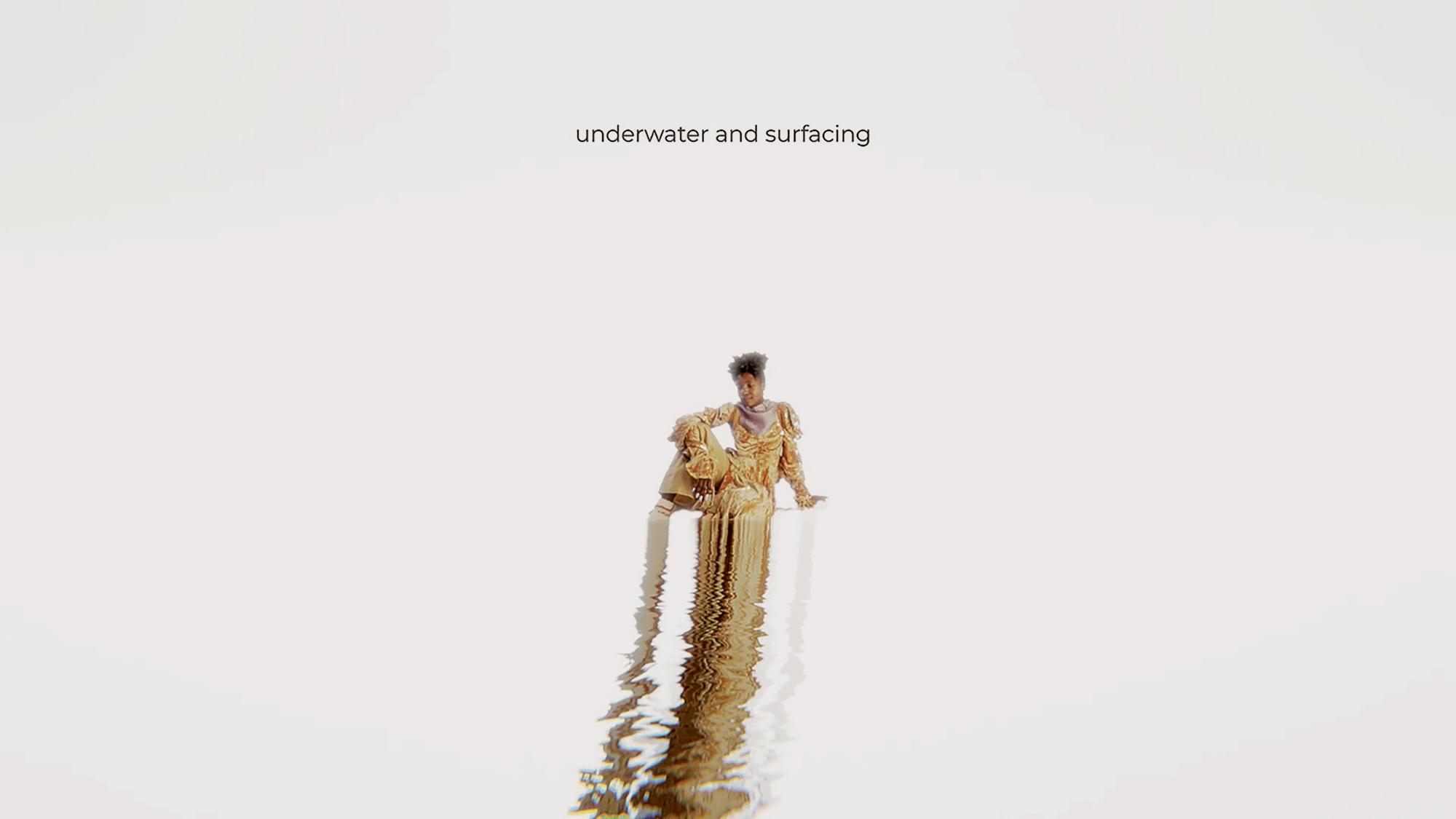
They have remarked that although film has a singular vision, it still feels very much like a collaborative medium. Fountain stars Alexandrina, as well as three dancers, and uses water visual effects as multiple metaphors to support the exploration of navigating Black lived experiences, memories, histories and futures. The work also draws on experiences of mental health and invisible disabilities. What is appealing to Hemsley in film is that there is less fixed time and space. In a live dance piece, the performances are planned for a specific date, and if you are too unwell to do them, the whole project becomes impossible. Not only does it allow for crip time in the planning, it also considers how disability unfolds in time and space.
Working with film allowed Hemsley to move the days they were being recorded, and the format allows for more contingency planning: if working on day x becomes impossible, there is an alternative that still makes the project possible. This contingency planning is a major part of Hemsley’s practice, and as discussed later, it also is part of Angela Alves’ practice. However, contingency planning is not something cultural institutions are always willing to do, as Hemsley states:
I was on bed rest and then had to really stay in my local area and couldn’t travel, the cinema basically insisted that – rather than we have this behind-the-scenes video that we could have – we’d built in a kind of contingency, you know. If I can’t do it, there’s a behind-the-scenes film. It has an interview with me in it. They were like, no, we need two to three speakers to replace you, and we need live presence. And so, then we did it. We then programmed all these other speakers to go on the tour instead of me. And again. It’s not an access-led model. Or it creates its own challenges when, again, it has to be live or nothing.
Hemsley showed a lot of understanding that in cultural institutions, »everyone is overworked across the board« and many institutions struggle to receive funding or to survive. Yet they also mentioned that sometimes the relationship to institutions can feel quite distant. They also posed the question of whether you can work with institutions that do not mirror your values, particularly if that creates risks: One instance was when a cinema showed their film, and they would have liked a mask requirement in place so that people who are vulnerable to Covid and still shielding could come, but it was not the cinema’s policy. In their own company, Yewande 103, Alexandrina mentioned that they are working on a collective care rider, which broadly outlines everyone’s needs but also how they want to respect people’s privacy within that and their right not to disclose conditions or care needs. In several of the interviews in the research projects, I found that care and access were closely linked, sometimes taking on each other’s meaning. Particularly in Hemsley’s work, it was made clear that one cannot exist without the other.
Surrender to the horizontal
For Angela Alves, too, it is central to think through access at every step in her work. In many of her pieces, she works with Athena Lange, a Deaf performer, and makes sure her pieces are fully accessible for Deaf audience members. She also offers formats such as audio description in order to provide access for blind and visually impaired audiences, and relaxed performances are part of her regular practice. A Relaxed performance means that audiences have explicit permission during a performance to move and make noise if that is what their body needs, and stimuli such as loud or sudden noises and bright lights are used sparingly and/or announced beforehand. This creates access for neurodivergent and learning-disabled audiences and can also make pieces accessible for audiences with chronic pain (Jess Thom, »Relaxed Performances – the FAQs«).
Much like Alexandrina Hemsley, the lockdowns allowed Alves to work in different ways. Before 2020, Alves’ practice already revolved around her own unavailability: due to her chronic illness, she never knows whether she will be able to work on a given day, and during a flare-up of her condition, she might struggle to stand or talk for a long time, things that are often required in live performance formats. Her piece REST, for example, is built around her own private bed, which is sent on tour with a sound installation of people visiting her in bed, resting with her, and talking about their relationship with rest, and audience members can themselves lie in bed as they listen and, as Alves phrases it, »surrender to the horizontal«. Another one of Alves’ performances, the lecture performance Clown Adapt, exists in different versions, one that is strenuous for Alves as it requires her to stand and talk for a long time, and one she can perform during an acute flare, as the audience takes over the activities of standing and speaking for her while she is lying down. These practices that distort the binaries between artist/audience, public/private and mobile/immobile point towards a multiplicity of approaches that together form a hybrid artistic practice informed by aesthetics of access.
In her interview, Alves discussed that she has not yet found a single approach to make her own work processes fully accessible to her because she herself does not find her needs easy to grasp. One thing she noted as important to her is that rest is part of her artistic practice – she does not rest in order to be productive and to be able to work but pays attention to what rest generates, what kind of states and dreamlike thoughts become possible. Horizontality, or the option to be horizontal, is as well part of her practice. All her works include a meditative or horizontal moment, or a moment where she can be off-stage, because she always tries to make rest and horizontality a possibility, both during rehearsals and during actual shows. Using and claiming the horizontal in performance might not only be a necessity, it is also a subversive act that can crip and queer bodies (Kreuser 122). For one of her pieces, 2020’s No Limit, rehearsals were meant to start in April 2020, right around the time the Covid-19 pandemic broke out in Germany. When lockdown started, Alves and the ensemble decided to create the piece on Zoom instead.
For Alves, she mentioned that this possibility was what allowed her to keep working as an artist, as she was in an acute episode of her chronic illness and would not have been able to go through rehearsals at the theater. Much like Hemsley, the changes that came with the pandemic allowed her to work in ways that were accessible to her.
In order to make the piece on Zoom, the ensemble had to get used to Zoom and to find ways sign language translation was always visible when working on Zoom. By working on Zoom and »cripping« the medium in order to work with the medium, the group engaged in what Fritsch and Hamraie call »crip knowing-making«:
Disabled people design our own tools and environments, whether by using experiential knowledge to adapt tools for daily use or by engaging in professional design practices. Crip technoscience conjures long histories of daily adaptation and tinkering with built environments [...]. Crip knowing-making forms the basis of political slogans such as Nothing About Us Without Us (Charlton, 2000), framing disabled people not just as design experts but also as epistemic activists whose politicized ways of knowing the material world also situate us to produce the material conditions that allow disability to thrive, in addition to remaking how disability is known and experienced. (Fritsch and Hamraie 7)
No Limit included many generative uses of access: audio description was built in as part of the text for everyone to hear, and several members of the ensemble used German Sign Language, sometimes without translating into spoken language or translating later, challenging hierarchies in theater that privilege a hearing, seeing audience, and instead the piece centered blind and Deaf audiences. It also played with the visible and invisible, for example, by explaining in a visual self-description that Alves is performing from her living room while using a virtual background because of her need to rest (Schmidt et al., 266). Furthermore, Alves extends this crip knowing-making to the way she deals with funding bodies, talking about cripping proposal budgets by including costs that are created by accessibility even if the budget format of a funder would not allow for that in theory.
Alves loves working with access, partly because of the structure and decision-making it simplifies: she says she does not see access as extra labor because for her it happens naturally and is a fun process, wanting to work with Deaf performer Athena Lange wanting her blind, deaf, disabled, and neurodivergent friends to be able to see her work. Like Alexandrina Hemsley, Angela Alves tries to build in contingencies in her work depending on her condition, but she also says that even though she’s had her chronic illness for about 15 years, she cannot say with certainty what will happen during an acute episode or what she will be able to offer in that moment or after.
Exploding timelines
Both artists start their working process with considering access first. That means their own access needs, but also possible needs of their collaborators. While Alves tends to be at times overwhelmed by the demands the role of artistic director brings, for both artists this also allows them to have more control of how access is part of the production, from the creation – and cripping – of a budget to the planning of contingencies.
Arseli Dokumaci quotes Snyder and Mitchell’s expression (27) »commitment to a politics of incoherency«, arguing that truly using disability as a method, without glossing over its particularities, means that a commitment to a politics of incoherency is necessary (Dokumaci). Both artists use disability, both their own and that of others, as an artistic method, and doing so means challenging binaries such as live/digital, artist/audience and mobile/immobile. Hemsley makes this clear by drawing a parallel between their »incoherent« practice and their incoherent bodies. Both artists switch between genres or mash them up, depending on their own needs and the needs of their collaborators. They show impressive adaptability and thinking where several alternate timelines exist. By holding multiple scenarios at the same time and engaging in contingency planning, they put Alison Kafer’s statement that »crip time is flex time not just expanded but exploded« into practice (27).
Both artists frame working with disability as a generative practice: Hemsley questions the assumption that live work is better both within institutions but also within themselves as an artist. Alves regards working with accessibility as a process that facilitates decision-making, because very often her own accessibility or that of audiences and her team drives artistic decisions. The flexibility both artists have in their work, which allows the work to travel outside of traditional touring methods, also gives the artists more independence, as it allows for fluctuating access needs. Both artists demand accessibility in their work, even when they cannot be physically present: In Alves’ piece REST audiences get to rest on her bed themselves, and Hemsley aims for audiences to wear masks during the screenings of Fountain. In doing so, they establish community without physical co-presence, and their work emphasizes that disability community does not require sharing physical space, as long as care and access for members of the community is embedded in the work.
Note: A slightly different version of this chapter will also be published in the forthcoming volume Independence and Collectivity: Configurations of Disability Performance, edited by Benjamin Wihstutz, Elena Backhausen and Mirjam Kreuser (Taylor and Francis, 2026).
References
Dokumaci, Arseli: »Disability as Method: Interventions in the Habitus of Ableism through Media-Creation«, in: Disability Studies Quarterly, 38.3 (2018), https://doi.org/10.18061/dsq.v38i3.6491.
Hamraie, Aimi und Kelly Fritsch: »CRIP Technoscience Manifesto«, in: Catalyst Feminism Theory Technoscience, Bd. 5.1 (2019), pp. 1–33. https://doi.org/10.28968/cftt.v5i1.29607.
Kafer, Alison: Feminist, queer, crip, Indiana 2013.
Kreuser, Mirjam: Crip-queere Körper: Eine kritische Phänomenologie des Theaters, Bielefeld 2023.
Magni, Sarah: Towards a Theatre of Neurodiversity: Virtual Theatre and Disability During a Global Pandemic, 2020, hdl.handle.net/10315/38370.
Mietola, Reetta und Karoliina Ahonen: »Lockdown Fits and Misfits: Disabled Young People’s Lives Under Covid-19 Lockdown«, in: Young, 29.4 (2021), pp. 100–117. https://doi.org/10.1177/11033088211032019.
Pieri, Mara: »When vulnerability got mainstream: Reading the pandemic through disability and illness«, in: European Journal Of Women S Studies, 29.1 (2022), pp. 105–115. https://doi.org/10.1177/13505068221090424.
Price, Margaret und Stephanie L. Kerschbaum: »Stories of Methodology: Interviewing Sideways, Crooked and Crip«, in: Canadian Journal Of Disability Studies, 5.3 (2016), p. 18. https://doi.org/10.15353/cjds.v5i3.295.
Margaret Price: »Un/Shared Spaces«, in: Jos Boys (Ed.): Disability, Space, Architecture, Milton Park 2016, pp. 155–172.
Emily Lim Rogers: »Virtual Ethnography«, in: Mara Mills and Rebecca Sanchez (Eds.): Crip Authorship: Disability as Method, New York 2023, pp. 93–99.
Yvonne Schmidt, Nina Mühlemann and Celestina Widmer: »Aesthetics of Access als Übersetzungsmoment. Angela Alves’ digitale Performance No Limit«, in: Robert Stock et al. (Eds.): Dis/Ability und digitale Medien, Wiesbaden2025, pp. 259–278.
Snyder, Sharon L. und David T. Mitchell: »How do we get all these Disabilities in here? Disability Film Festivals and the Politics of Atypicality«, in: Canadian Journal Of Film Studies, 17.1 (2008), pp. 11–29. https://doi.org/10.3138/cjfs.17.1.11.
Thom, Jess: »Relaxed Performances – the FAQs«, in: Touretteshero, Februar 22nd, 2019, www.touretteshero.com/2016/03/16/relaxed-performances-the-faqs (last access 29.06.2024).
Winter, Noa: Aesthetics of Pain, Fatigue, and Rest: Working Methods of Chronically Ill Artists within Disability-led Performances. muse.jhu.edu/article/893119.
Wong, Alice: »I’m disabled and need a ventilator to live. Am I expendable during this pandemic?« Vox, 4 (2020), www.vox.com/first-person/2020/4/4/21204261/coronavirus-covid-19-disabled-people-disabilities-triage (last access 29.06.2024).